
Red Lake County Release Dates
A Red Lake County scheduled release date is a calculation based on the sentence and the rules that apply at that point. Actual release is the event when a specific agency ends custody. The two can differ. A court may amend the sentence, another agency may lodge a detainer, disciplinary confinement may postpone supervised release, or an earned credit decision may change the prison portion. The releasing agency's dated record is what confirms the event.
A pretrial detainee at Northwest Regional Corrections Center normally has no sentence-derived date. Release may depend on bail conditions, a court order, dismissal, disposition, a warrant or hold, and the time needed to process the change. The Red Lake County court file explains the legal authority. NWRCC confirms when its physical custody ended and whether another agency took custody.
| Custody status | Date source | What must be confirmed |
|---|---|---|
| Pretrial at NWRCC | Court orders and jail status | Bond, conditions, holds, and processing |
| Serving a county jail sentence | Judgment plus NWRCC computation | Jail credit, local good time, discipline, and holds |
| Serving an MNDOC term | MNDOC sentence information and Central Records | Statutory split, discipline, eligibility, credits, and detainers |
| Limited board case | Board record plus MNDOC | Eligibility, decision, conditions, and any later change |
Find Red Lake County Release Timing
Start with the custody system. A Red Lake County arrest is generally housed at NWRCC in Crookston because Red Lake County has no operating jail. A commitment to the Commissioner shifts the search to MNDOC. The state locator is not a county-jail archive, and an NWRCC roster entry cannot answer a state-prison date question.
- Read the Red Lake County District Court case through Minnesota Court Records Online. Identify whether the person is awaiting trial, serving local time, or committed to MNDOC. Use the local District Court page for the Red Lake County office and calendar route.
- For NWRCC custody, ask the jail and court about the controlling order, sentence, jail credit, local good-time calculation, pending holds, and any set release processing.
- For an executed state sentence, search the MNDOC public locator by name or MNDOC Offender ID. Match demographic, offense, and court-file details before relying on sentence information.
- If the public detail is incomplete or the date wording is unclear, contact MNDOC Central Records. Ask for the current sentence calculation and the official meaning of each date.
- Near the expected event, confirm custody with the responsible agency and use the proper notification service. County events use Minnesota VINE; state-prison notifications use Minnesota Haven.
The locator may show sentence and release information when applicable. Research did not verify the precise label used for a future date on a populated public record, so no field should be assumed to be named projected or tentative. Official sources variously use release date, scheduled supervised release date, and projected release date in different contexts. Central Records can resolve what a displayed date means for the specific sentence.
The Red Lake County release-record search explains how to pair the court order with the jail's actual liberation or transfer entry. That pairing prevents a transfer to MNDOC, ICE, or another warrant holder from being mistaken for release into the community.
Red Lake County State Release Formula
Minnesota does not use a general 85-percent rule. For an ordinary executed determinate sentence for an offense committed on or after August 1, 1993, Minnesota Statutes section 244.05 generally divides the fixed term into two-thirds imprisonment and one-third supervised release. Supervised release is still part of the sentence. It is not the same as final discharge.
The supervised-release statute page below is a direct source for the ordinary structure and its exceptions.
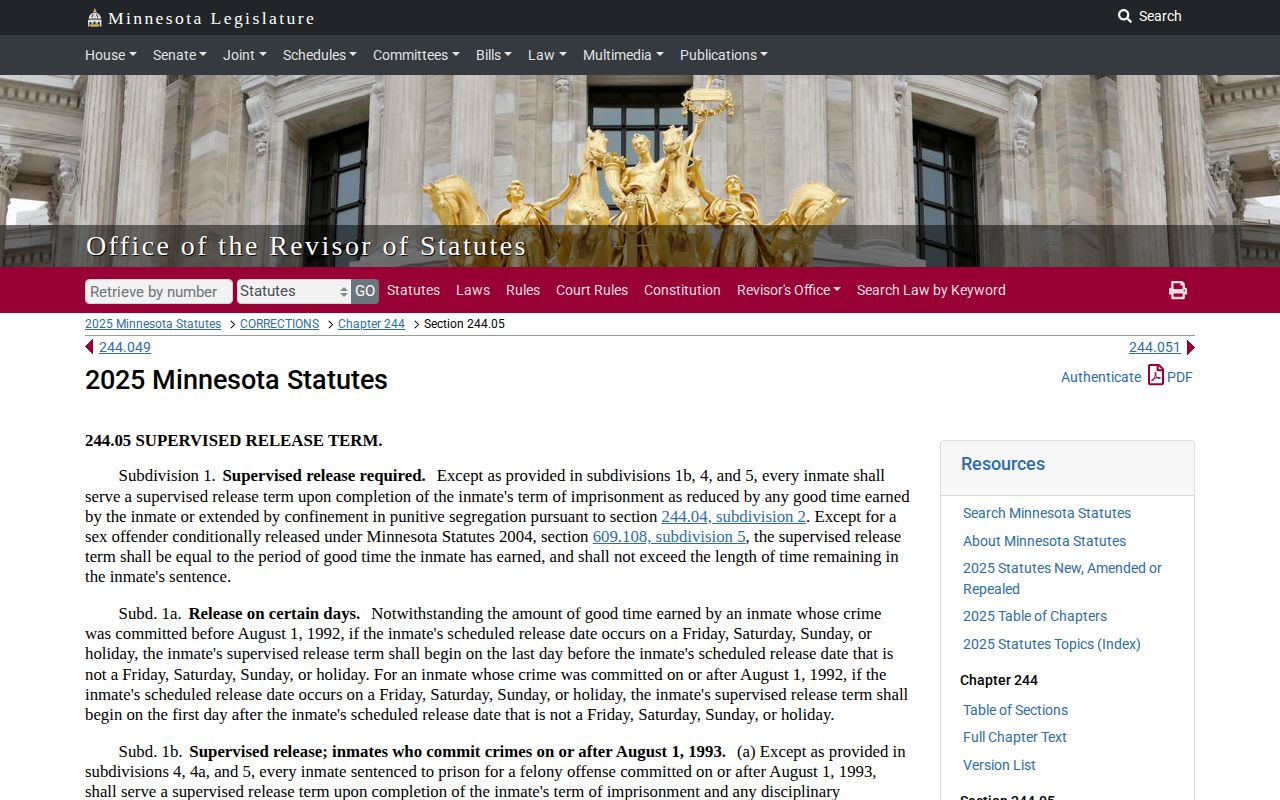
The statutory split is a framework, not a person-specific calculator. Offense date, sentence type, disciplinary confinement, earned credit, detainers, and special eligibility rules can all matter. Older indeterminate terms and specified life or juvenile-at-offense cases require separate analysis. The Minnesota Supervised Release Board handles only its defined categories, not each ordinary modern prison release.
Final discharge comes later, after the supervised portion or other jurisdiction ends. A person released from prison may remain searchable in the MNDOC locator while still under jurisdiction. Once fully discharged, the person may fall outside the locator's stated scope, making Central Records and the court file more important.
Note: Two-thirds imprisonment and one-third supervised release describe the ordinary state structure, not a promise of any individual gate date.
Red Lake County Earned Release Credit
The Minnesota Rehabilitation and Reinvestment Act adds a separate earned-credit path. Under section 244.44, an eligible person may earn incentive release credit by completing objectives in an individualized rehabilitation plan. Credit is not automatic. The current cap is 17 percent of the total executed sentence, and credit cannot reduce imprisonment below one-half of that sentence. The supervised-release term is not shortened by this prison credit.
The official earned-credit statute is captured below.
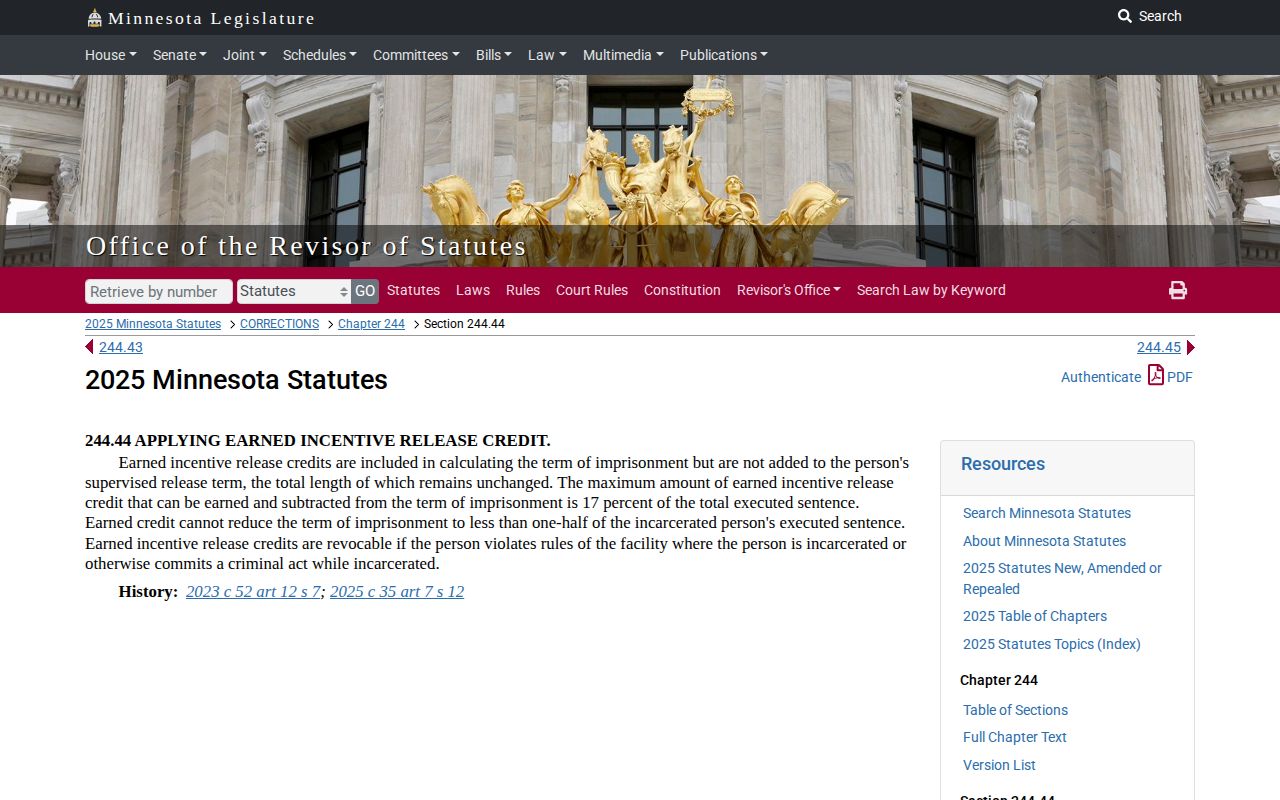
MNDOC can revoke earned credit for facility-rule violations or criminal acts in custody. Section 244.45 lists excluded people and sentence types, including categories that must remain under other rules. No one should assume the maximum applies without an agency calculation. Earned compliance credit is different: it can reduce active supervision after release under stated criteria, but it does not create more credit against the prison term.
The broader MRRA statutory framework places both earned incentive and compliance credit in context. Its captured text provides the governing limits that a simple release-date calculator would miss.
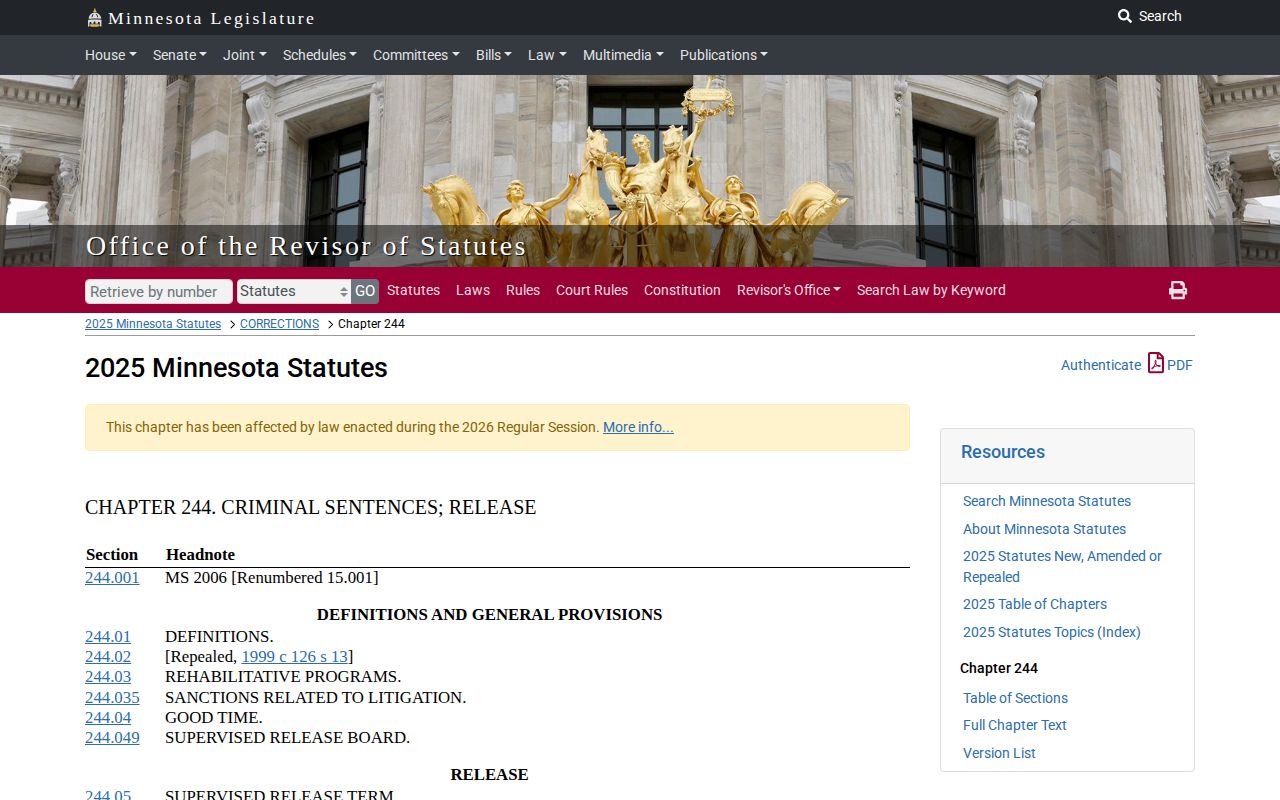
For a Red Lake County state-prison case, use the actual MNDOC computation. The sentence length alone cannot reveal completed plan goals, credit awards, revocations, ineligibility, or later recalculation.
Red Lake County Release Calculation
County jail time and state prison time use different calculations. NWRCC's handbook recognizes local good time and possible loss through discipline. It also discusses court-authorized work release and Sentence to Service. Those programs are not final release because the participant remains subject to custody rules and returns as required. The state two-thirds formula cannot simply be applied to a local Red Lake County jail sentence.
A local calculation may depend on the judgment, credit for time already served, the jail's good-time determination, discipline, work-release status, and any outside hold. The court and NWRCC must supply those facts. Even when a rough date seems easy to count, another county warrant, a state commitment, or an immigration or federal detainer may change where the person goes next.
This local-state split is the central Red Lake County date quirk. NWRCC holds county detainees outside Red Lake County, while MNDOC manages people committed to state custody. Use the institution that currently controls the sentence. A statewide sentence rule does not override the regional jail's lawful computation of a county term.
Work release can also create a false impression that the Red Lake County jail term has ended. NWRCC participants may leave for an approved activity but remain classified, monitored, tested, and required to return. Sentence to Service has a similar need for court authority and facility administration. Neither status should be entered as the final release date without the jail's custody record. A lawful liberation entry or transfer record is the better endpoint.
The official NWRCC handbook page is the Red Lake County regional-jail source for local custody rules. Check the current handbook and ask NWRCC to explain how its provisions affected the specific sentence.
For a sentenced NWRCC inmate, ask for the date used in the facility calculation and each component that affected it. The response may identify jail credit, available good time, disciplinary loss, the controlling court order, or a hold. For an MNDOC prisoner, ask Central Records for the department's calculation instead. Keeping the questions separate reduces the risk of applying a prison credit rule to a jail sentence.
Red Lake County Date Changes
A projected date can move before the release event. Some changes alter the sentence calculation. Others leave the calculation intact but prevent community release because another authority has a valid claim to custody. Asking only for a date can conceal that key destination issue.
| Factor | Possible effect | Best confirmation |
|---|---|---|
| New or amended court order | Changes sentence, credit, or release authority | Court Register of Actions and signed order |
| Jail-credit correction | Moves a local or state computation | Court, NWRCC, or MNDOC calculation |
| Disciplinary confinement or lost good time | May delay release | Responsible facility or MNDOC |
| Earned-credit grant or revocation | Adjusts eligible prison time | MNDOC sentence administration |
| Detainer or warrant | May cause transfer instead of community release | Releasing and receiving agencies |
| Limited board action | Affects only a case within board authority | Board record and MNDOC |
| Administrative recalculation | Corrects or updates a prior date | MNDOC Central Records or jail records |
For old offense dates, section 244.05 also has a weekend and holiday rule. Crimes before August 1, 1992, and crimes on or after that date are treated differently when a scheduled release falls on certain days. The rule can move the start to a qualifying weekday, but it is not permission to calculate a person's date without the full sentence record.
A Red Lake County date shift does not always change the sentence's total length. A detainer can mean that one agency ends custody on schedule while a second agency immediately takes over. Likewise, a release from prison to supervised release ends confinement but not the MNDOC term. Ask both when custody ends and what legal status follows. Those two answers are more precise than asking whether the person will simply be free.
Confirm Red Lake County Release
Close to a scheduled event, confirm with the agency that holds custody. For NWRCC, ask whether custody ended, when it ended, by what authority, and whether the person transferred. For MNDOC, check the public record and contact Central Records at co-records.doc@state.mn.us or 651-361-7200 when the sentence information needs explanation.
Automated notification is useful but does not replace the source record. Minnesota VINE receives county detention events, including NWRCC changes, after the jail submits them. Minnesota Haven covers state-prison custody and release notices. The Red Lake County VINELink inmate search details the county alert path and its timing limits.
Record the date and time of any call and exactly what staff confirmed. Then retain the court order, facility response, and later status update. That small record trail separates a forecast from an actual Red Lake County release and makes clear whether the next step was the community, supervision, or another custodian.
When two official sources appear to conflict, compare their timestamps before assuming either is wrong. A court order can authorize release before jail processing is complete. A roster can be generated before the event and remain posted afterward. A VINE notice can arrive after the facility submits its change. Requesting the underlying dated release or transfer entry usually resolves that sequence.
Note: A projected date is most reliable when the court record, sentence calculation, and current custody status all refer to the same person and case.