
Where BOP Releases Go
A federal prison release may send a person to the community, supervised release, another law-enforcement authority, or a custodian acting on a detainer. Supervised release is a federal court-ordered period after imprisonment. It is not continued BOP confinement, but federal jurisdiction and conditions may remain. A transfer to another authority ends BOP custody without making the person free.
For Red Lake County, federal relevance is limited but real. NWRCC says it may house people for the U.S. Marshals Service. A move from NWRCC to USMS is a transfer. If the person is later designated to a BOP institution, the BOP locator becomes the right public search. Link each stage through dates, identifiers, the District of Minnesota docket, and custody records.
Confirm BOP Release Status
The BOP Inmate Locator supports searches by BOP register number, FBI number, DCDC number, INS number, or first and last name. Name searches can be refined by age, race, and sex. Results include the name, register number, age, race, sex, release date, and location or status. Match the register number whenever possible.
- Search the BOP locator by federal identifier or full name.
- Compare identity fields before opening or relying on a result.
- Read the release date and location or status exactly as displayed.
- Check the federal docket for a release order or conditions.
- Request the underlying federal custody record when destination or method matters.
“Released” or “Not in BOP Custody” means BOP no longer holds the person. BOP warns that another authority or supervision may apply. First Step Act recalculations can also alter dates. Do not convert that status into a statement of freedom without checking the receiving authority and docket.
BOP Release Records Contact
The locator is the quick public route. A richer release record may include release method, detainer, destination or transportation, supervision office, and reporting instructions. BOP’s Notice of Release and Arrival form shows these possible fields, though not all appear publicly in the locator. Use the federal docket or an official records request for case-specific proof.
Federal Bureau of Prisons
Public route: BOP Inmate Locator
U.S. Marshals Service FOIA
Office of General Counsel, FOIA Unit, CG-3, 15th Floor
Washington, DC 20530-0001
Public Liaison: 703-740-3943
USMS has no nationwide public name locator equivalent to BOP. Its prisoner custody and disposition files are requested through FOIA and may be limited by privacy or law-enforcement exemptions. Identify the person, federal number if known, relevant dates, District of Minnesota connection, and exact custody or disposition record sought.
BOP Federal Custody Scope
BOP operates the federal prison system. It is not a Red Lake County jail and not the Minnesota Department of Corrections. No federal prison was identified inside Red Lake County. A local arrest does not create a BOP record unless the matter enters federal prosecution or custody. NWRCC’s USMS population should therefore be traced through the marshals and federal docket before assuming BOP designation.
The official BOP victim resources page provides federal release-notification context. 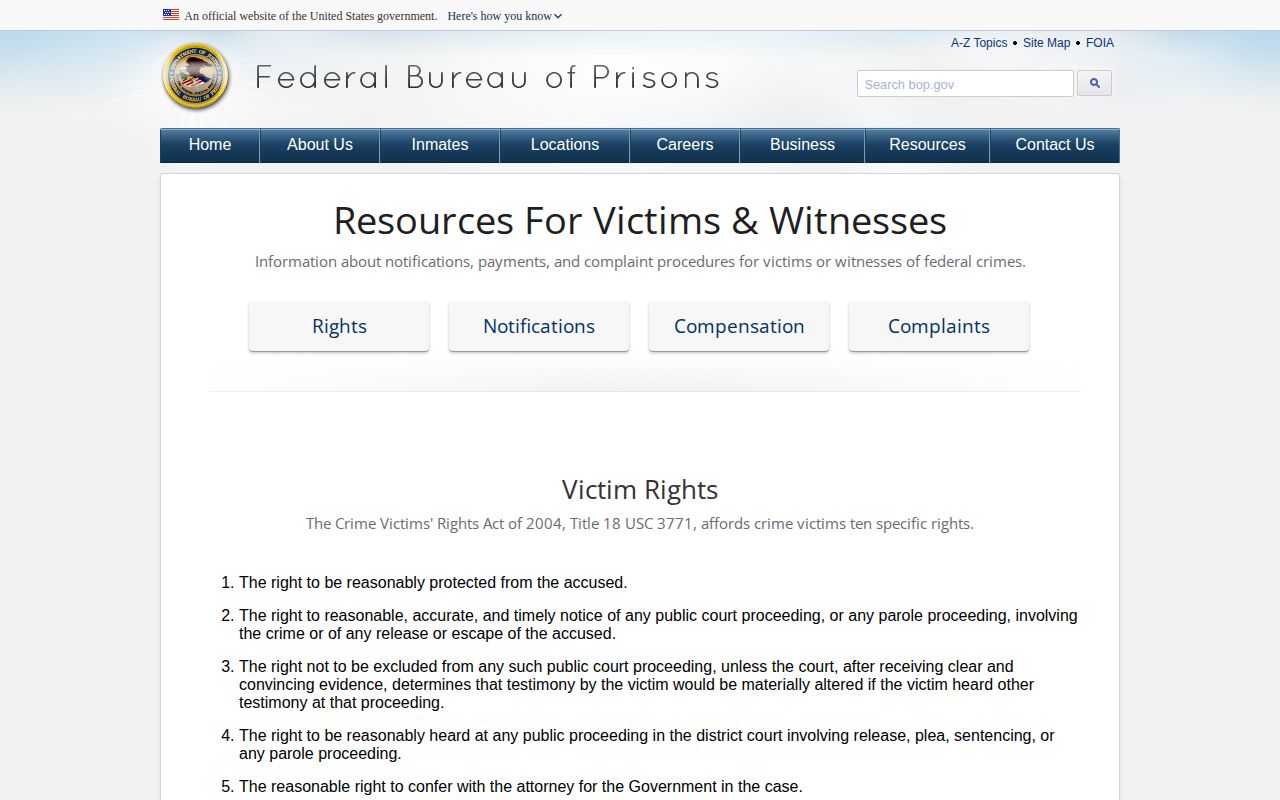 The captured federal resource belongs to BOP custody and should not be confused with Minnesota VINE or MNDOC Haven.
BOP Release Result Limits
A date in the locator is strong evidence of the BOP record, yet the label and custody scope matter. A released person may have federal supervised release, state custody, local custody, immigration detention, or another detainer. The locator does not promise to display every destination or reporting term. It also warns that release-date calculations may change.
When a Red Lake County case moved from NWRCC to USMS, obtain the NWRCC transfer recipient and timestamp. Then use the federal docket to identify the federal case and BOP to track designated prison custody. This sequence keeps a county-jail handoff, federal detention, federal imprisonment, and community release from collapsing into one event.
Note: “Not in BOP Custody” answers only the BOP question and does not establish where the person is now.
Request Federal Release Records
A focused request works best. Ask for custody dates, transfer or release method, destination, detainer information, and disposition for the identified federal custody period. Give the register number or other official identifier privately. If the sought record belongs to USMS rather than BOP, send it to the marshals. If it is a court order, use the District of Minnesota docket or clerk.
FOIA exemptions can restrict personal and law-enforcement information. A partial response or denial is not proof of continued custody. Ask for the stated exemption and narrow the request to the release or transfer facts needed. The Red Lake County release records overview shows when a federal search should follow an NWRCC transfer rather than replace the local record.
BOP and County Release Differences
NWRCC holds pretrial and county-sentence populations plus some contract or outside-custody cases. BOP holds people in the federal prison system. Minnesota VINE tracks county detention events, while BOP uses its own locator and federal notification resources. MNDOC is a third system for Minnesota state prisoners. A person can move between authorities, but each database answers only for its custodian.
For a sound release account, preserve the sequence: NWRCC transfer record, USMS custody information, BOP result, federal court order, and any later receiving-agency record. Dates can overlap because records post at different times. Prefer the underlying dated agency record and request clarification if sources conflict. Never settle the conflict by assuming that disappearance from one locator means community release.
Confirm Federal Release Records
A federal release result is strongest when tied to the correct identifier and docket. Names alone can produce several people. Keep the BOP register number, exact status wording, displayed release date, and retrieval date. Then compare the District of Minnesota case for an order, sentence, and supervision terms. If a transfer began at NWRCC, preserve the regional jail’s recipient and transfer time as the first federal-custody link.
USMS custody can exist before BOP designation. The marshals may hold a federal defendant or arrange transport without a public nationwide locator. A BOP no-result therefore does not prove that no federal custody occurred. The federal docket and a focused USMS FOIA request can address the period before BOP or a disposition that never resulted in a BOP prison record.
A BOP release date also does not reveal every release method or destination. The BP-A0714 release-and-arrival form shows that underlying records may address detainers, destination, transport, supervision office, and reporting. Those fields are not guaranteed in public locator output. Request only the record needed and expect lawful privacy or enforcement limits.
If another authority received the person, switch systems after obtaining the named recipient. State custody belongs with that state, immigration detention with ICE, and local detention with the named jail. Federal supervised release belongs with the federal court and supervision record, not a county probation search. Each source confirms its own segment.
Finally, do not confuse federal release notification with Minnesota’s systems. Minnesota VINE covers county detention custody changes, and Minnesota Haven covers state-prison notifications. BOP provides federal tools and victim resources. Selecting by custody authority avoids a false no-result and gives the user a traceable route to the correct record.