
Where MNDOC Releases Go
A Red Lake County detainee enters state custody only after a legal commitment or transfer from NWRCC. From that point, MNDOC is the custody system. Release from a state prison commonly means the incarceration part of an executed sentence ended and supervised release began in the community. MNDOC jurisdiction may continue through that supervised term. A person can therefore be out of prison while still appearing in the public locator.
Final discharge means the state sentence and supervision have ended. A fully discharged person may fall outside the locator’s stated scope. Other outcomes can include continued confinement, a detainer, a transfer, or a limited-board decision. Do not describe a prison release as a county-jail release. The MNDOC status, applicable release information, Central Records response, and sentencing court file provide the state record chain.
Confirm MNDOC Release Status
Open the MNDOC Public Viewer and search by first and last name or MNDOC Offender ID. The tool supports associated or old names and prefix matching. New commitments may take several business days to appear. Select a result only after comparing the identifier, demographic information, offense, and court file number. Similar names are not enough.
- Search the MNDOC locator by name or state offender ID.
- Open the matching detail and read Current Status Information.
- Review offense, court file, and any populated sentence or release information.
- Use the Red Lake County court file to confirm the commitment and sentence.
- Contact MNDOC Central Records when a date, status, or final discharge is unclear.
The public locator covers adults committed to the Commissioner who remain under MNDOC jurisdiction, including many people released from prison under supervision. It is not an NWRCC archive. A no-result may mean no state commitment, final discharge, different identity data, or an entry delay. The Red Lake County custody comparison helps separate jail and prison routes.
MNDOC Release Records Contact
The public detail page directs sentence, release-date, and status questions to the facility or Central Records. Use Central Records for an official explanation when the public result is absent or unclear. State the person’s name, MNDOC ID if known, Red Lake County court file, and the precise record sought. Keep private identifiers within the official request.
Minnesota Department of Corrections
1450 Energy Park Drive, Suite 200
Saint Paul, MN 55108
651-361-7200
Fax: 651-642-0223
co-records.doc@state.mn.us
Ask for the release or discharge status, applicable sentence dates, and the source record supporting the answer. The exact future-date label on a populated public record was not verified in the research. Do not assume the locator calls a date “projected” or “tentative.” Central Records is the authoritative route for interpreting a person’s state sentence and current state jurisdiction.
MNDOC Statewide Prison Records
MNDOC facilities are statewide state prisons for people committed to the Commissioner. No state prison was identified in Red Lake County. NWRCC houses local detainees before a state commitment and is operated by TCCC, not MNDOC. Once the court commits a person to state custody, the MNDOC locator and records office replace the regional roster as the main custody sources.
The public detail shell can include demographic information, the MNDOC ID, DOC name, aliases, birth date, current status, current offense, highest-ranked offense, court file numbers, and sentence or release information when populated. Court file numbers link the state custody result back to the Red Lake County case. They are useful matching tools, but each field must be read in context.
MNDOC Release and Discharge
Supervised release is the community part of many executed Minnesota prison terms. It is not the same as probation, which is imposed by a court, and it is not final discharge. Ordinary modern determinate sentences generally do not require a traditional parole-board grant. A limited Supervised Release Board handles specified life, older indeterminate, and certain juvenile-at-offense cases.
Minnesota’s ordinary structure for qualifying executed terms is generally two-thirds imprisonment and one-third supervised release under section 244.05, subject to discipline and other rules. Minnesota is not an 85-percent state. MRRA earned incentive release credit adds a separate framework for eligible people and cannot be promised. The successful MRRA eligibility source shows statutory exclusions. 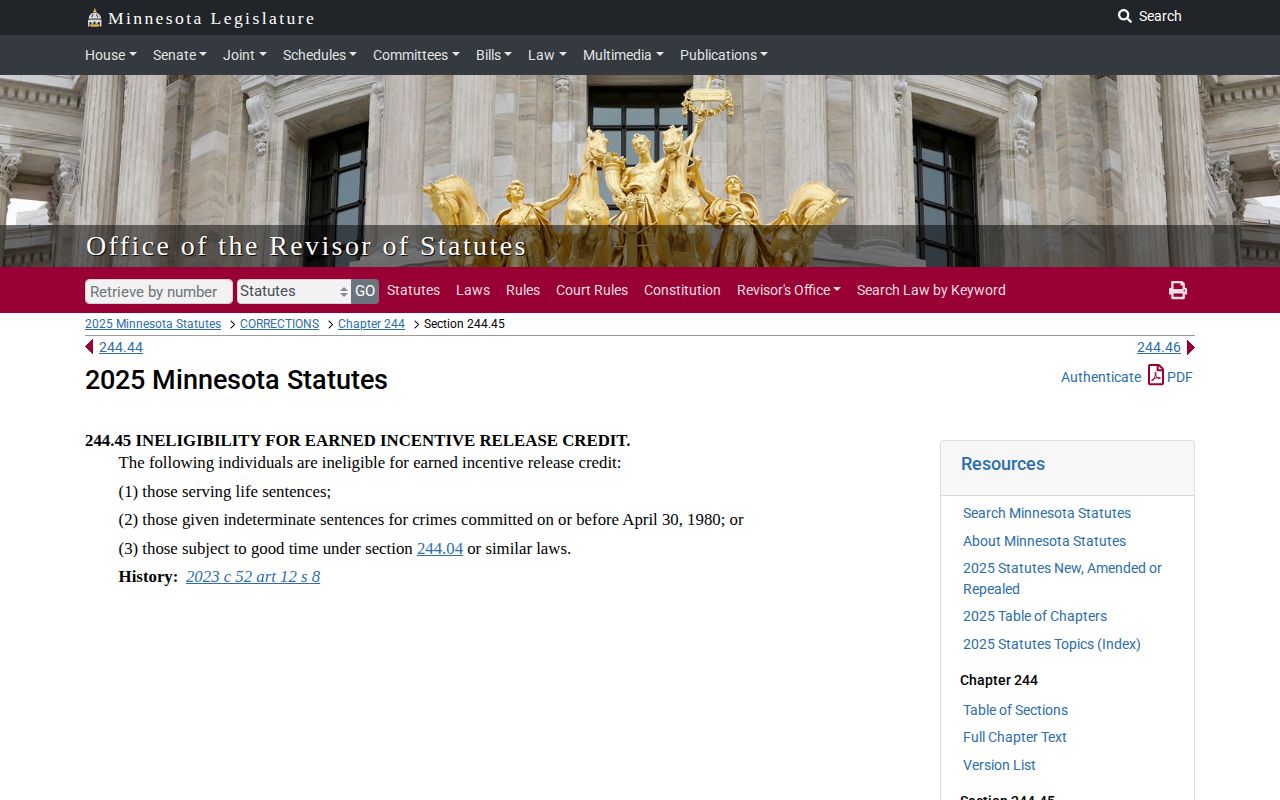 The captured statute underscores why an individual date requires the actual sentence record.
MNDOC Release Date Changes
A scheduled state release date can change because of disciplinary confinement, a corrected sentence, a detainer, earned-credit action, appeal, amended order, limited-board action, or administrative recalculation. The MRRA framework allows eligible people to earn incentive release credit through individualized plan objectives, within statutory caps and exclusions. Credits can also be revoked. Earned compliance credit after release is different and should not be treated as prison-release credit.
For a Red Lake County case, compare three records: the sentencing order, the MNDOC detail or Central Records response, and any later court amendment. Minnesota Haven supplies state-prison custody and release notifications, while Minnesota VINE is the county-jail notification system. Registering in the wrong system may miss the event even though the original case began in Red Lake County.
Note: A state-prison release may leave MNDOC jurisdiction active until the sentence’s final discharge.
MNDOC Release Record Conflicts
If the locator and court record appear to disagree, note the date and exact field from each source. A court sentence can explain the legal term, while MNDOC calculates and administers the prison and supervision portions. Later discipline, credit, or orders may alter the working date. Ask Central Records to clarify the underlying state record rather than choosing the result that seems more favorable.
A final-discharge request may be necessary when the locator returns no person because its stated population is limited to adults still under MNDOC jurisdiction. The court file can confirm the original sentence and later entries, but MNDOC holds the state custody and discharge record. Keeping those roles distinct produces a reliable account of where the person went and when state authority ended.
Confirm MNDOC Discharge Records
A state record should distinguish four points: commitment to the Commissioner, confinement at a state facility, release from prison under supervision, and final discharge from MNDOC jurisdiction. The public locator can cover the middle stages while jurisdiction remains. Central Records and the sentencing court become more important after final discharge, when the person may no longer fit the locator’s stated population.
For an older Red Lake County case, give Central Records the court file and MNDOC ID if available. Ask for the specific sentence, release, supervision, or discharge record rather than a broad corrections file. Compare the state answer with the court’s sentencing and amended-order entries. A county roster is not useful merely because the conviction began with an arrest in Red Lake County.
Notification also follows custody type. Minnesota Haven handles MNDOC prison custody and release events. Minnesota VINE handles county jail or detention events such as NWRCC custody changes. A person transferred from NWRCC to MNDOC can cross from one notification system to the other. Register with the system that currently holds or supervises the person.
Sentence language should remain exact. Probation is a court sanction and differs from supervised release after state imprisonment. Final discharge ends state jurisdiction. A detainer is a request or basis for another authority to hold or receive a person. Defining these terms prevents a locator status from being overstated and keeps the state-prison route separate from county custody.